A private led industry body for the Philippine ube sector
IV.Heritage

The heritage of Philippine ube

Dioscorea alata has been cultivated in the Philippine archipelago for centuries — a staple of upland agriculture, of household memory, and of regional identity.

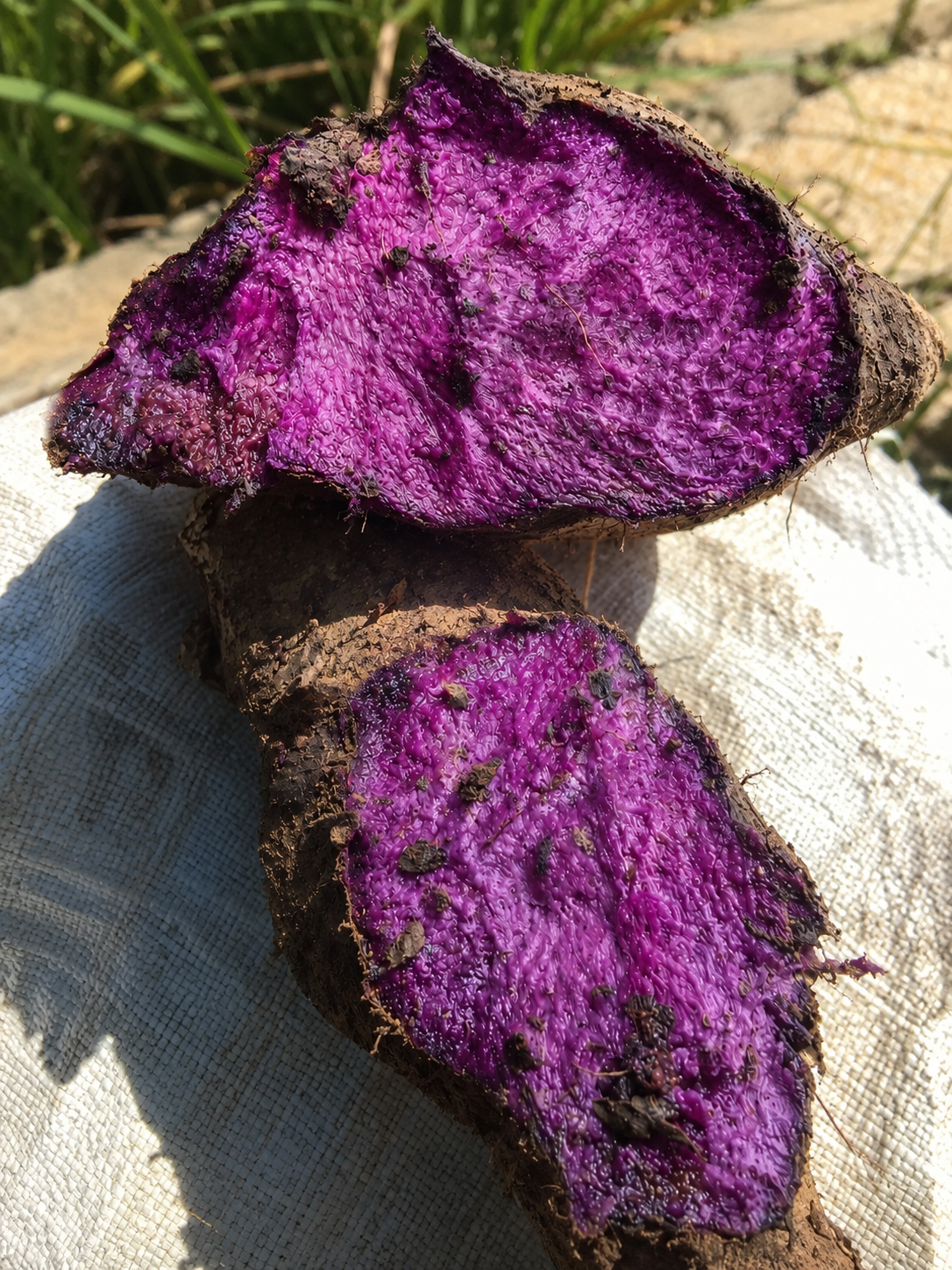
Freshly harvested ube tubers, one halved to reveal the violet flesh, resting on a sack in the field.
Fig. II — Heritage tuber, freshly lifted. Field documentation.

A crop, not a colour

Ube — Dioscorea alata L. — is a true yam: a vining perennial whose tubers, when cut, show the violet flesh that has come to stand for the crop in the popular imagination. It is not taro (Colocasia esculenta), and it is not the dye that has come, in many markets abroad, to be sold under its name. It is a cultivated plant with a history and a place.

Regions of cultivation

Ube is grown throughout the Philippine archipelago, from the uplands of Luzon to the islands of the Visayas and Mindanao. Bohol is the historical centre of the prized kinampay lineage — a deeply pigmented, aromatic variety long held as the standard of quality. Other regions maintain their own heritage cultivars, each adapted to its soils and seasons.

Cultural significance

Ube enters the Filipino table as halaya, as a sweetened paste folded into rice cakes and breads, and as the colour and flavour of celebrations. It is a household vocabulary: the crop is recognized by name, by texture, and by the memory of a particular grandmother's preparation. To steward ube is to steward a piece of that vocabulary.

Botany, in brief

Dioscorea alata is a climbing vine that produces a single large underground tuber per growing season, typically harvested eight to ten months after planting. The tuber's characteristic violet pigmentation derives from anthocyanins naturally present in the flesh. Cultivars vary widely in colour intensity, in aroma, and in the moisture and starch composition of the cooked tuber.

Why heritage matters here

The Association's standard is built on this heritage. Origin is not a marketing claim; it is the entire premise of the crop's value. Where the lineage is known and the chain of custody is documented, ube can be recognized for what it is — and the value of that recognition can return to the regions and the people who have kept the crop alive.